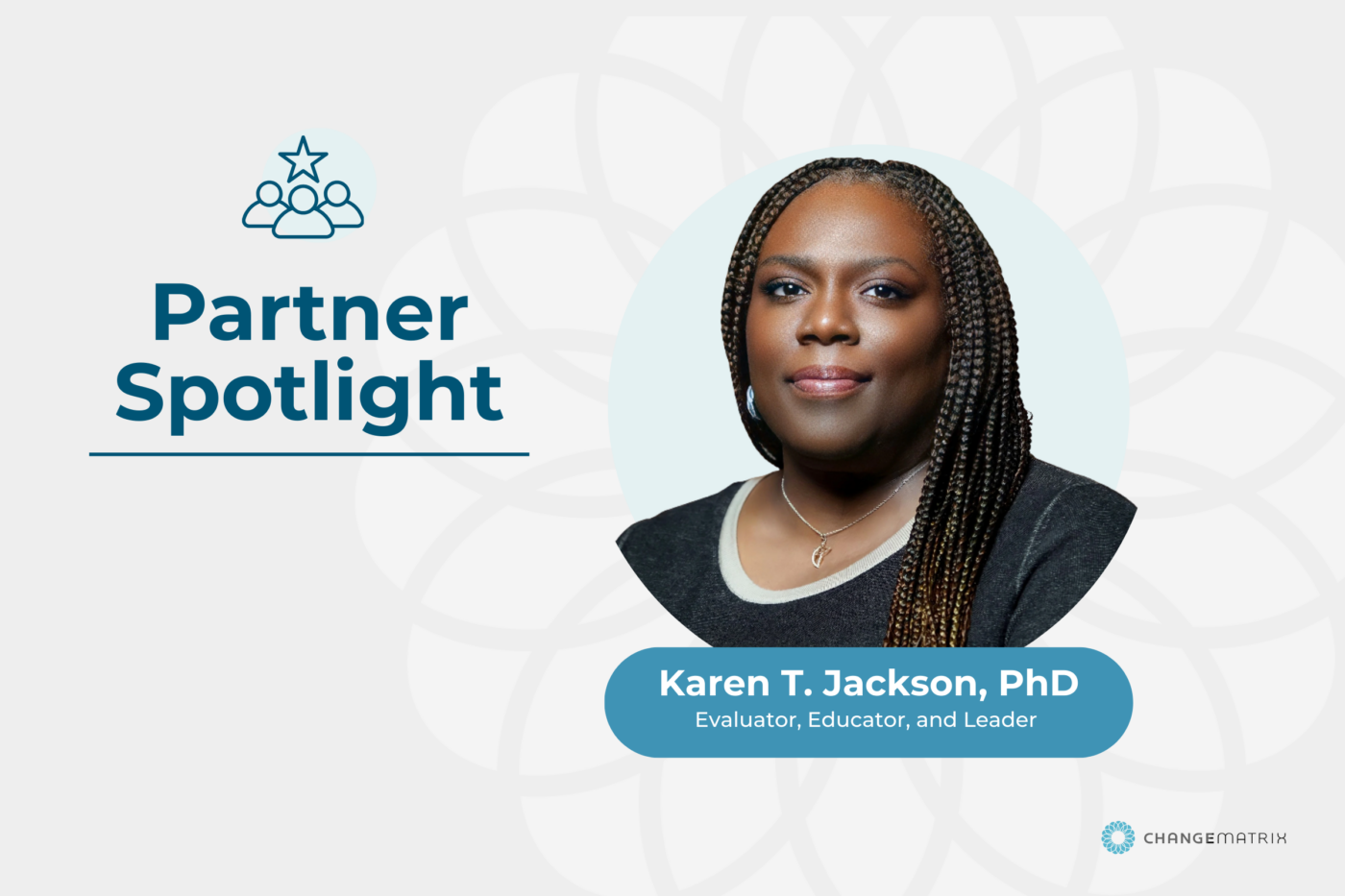
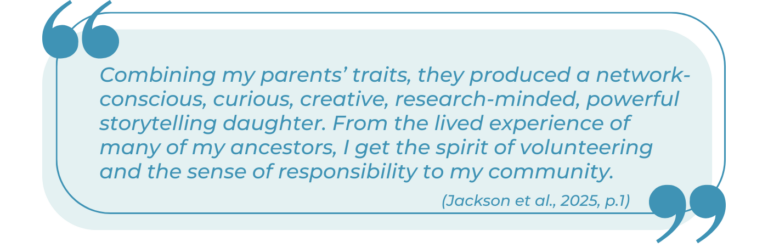
Showing up as a Black woman in leadership spaces means bringing my full story with me—my lineage, my losses, my faith, my questions, and my commitments to community. I come from people who taught me that story is a way to learn about myself, others, and the world around me. Story is how we pass down wisdom, survive harm, and imagine futures we have not yet seen. As a researcher, evaluator, leader and connector of people and networks, I believe stories are not the opposite of rigor—they are a form of evidence. Stories shape how we define problems, how we design solutions, and how we decide what “success” even means. Women’s stories in particular matter because they reveal dimensions of care, harm, resilience, and labor that often go unnamed in formal leadership spaces.
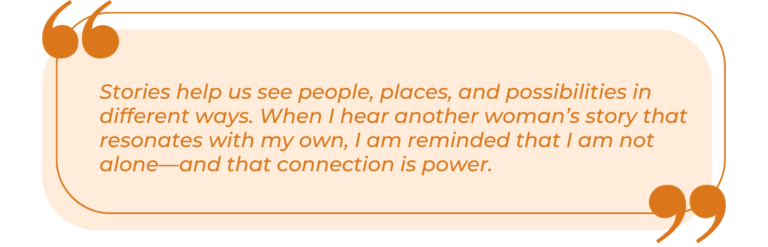
My identity as a Black woman shapes how I see power and how I hold responsibility. I am aware of how easily well-intended leadership can reproduce harm when it is disconnected from lived experience. In community-engaged work, particularly in violence prevention where restoration and resilience go hand in hand, I have learned that leadership is more than arriving with answers. Leadership creates space for people to name what safety, dignity, and belonging mean to them. In this environment, story becomes a method of accountability. When women share their stories, we hear echoes of our own fears and strengths. Listen and we also hear that which systems often silence. Those stories shape my decision-making, slow me down when metrics try to rush me, and remind me that transformation is rarely linear and mostly is relational.
Intersectionality also shapes how I lead. Race, gender, class, and professional identity intersect in ways that shape whose knowledge is treated as legitimate. As a scholar trained in research methods and evaluation, I’ve had to unlearn the idea that objectivity requires emotional distance. Critical and Afrocentric approaches to evaluation invite us to examine whose frameworks we inherit and whose stories are excluded by them. This matters deeply in leadership roles, including my service in national and international professional spaces, where I have seen how easily dominant norms become default standards. Diverse leadership changes who is in the room and it changes the questions that get asked, the risks that are noticed, and the futures that become imaginable.
Women’s storytelling is also a form of future-building. Drawing from freedom dreaming traditions, I believe leadership must hold space for imagination alongside strategy. With new visions, we know what to build and what to dismantle. When women, particularly Black women and women from marginalized communities are supported to tell their stories, research their realities, and shape policy and practice, leadership becomes more than management of what is; it becomes a practice of envisioning what could be. A real strength of including Black women’s stories is the depth of accountability to communities we bring. Our stories strengthen our collective capacity to lead with care, courage, and creativity.
I believe research and evaluation are tools for telling the stories that bridge the gap between people’s needs and the systems meant to serve them. Ultimately, showing up as a Black woman in leadership spaces means refusing to separate who I am from how I lead. My leadership is rooted in connection to family, to community, to the stories of women who taught me that survival is not the same as freedom, and that freedom requires both truth-telling, imagination, creativity and doing the thing that maybe is hard or unpopular. Leadership tables that center different women’s stories, intersectionality, and community wisdom will transform how leadership itself is practiced and change the ways we live, move, and breathe.
References
Jackson, K., Sakho, J., & Johnson, I., (2025). Participatory action research: collaborating with communities to codesign mixed methods research for the purpose of advocacy, funding, and research. In Sage Research Methods: Data and Research Literacy. SAGE Publications, Ltd., https://doi.org/10.4135/9781036222512
Jackson, K. T. (2023, March 30). Personal journal entry in preparation for a panel discussion entitled The Power of Women’s Stories.
Resource
Jackson, K. T. & Blackmon, A. T. (2025, November 21). Courageous and Critical Conversations. Building Transformative Internal Dialogues for Engaging Communities Sharing Leadership in Evaluation. https://www.katalystinnovative.com/blog/courageous-amp-critical-conversations