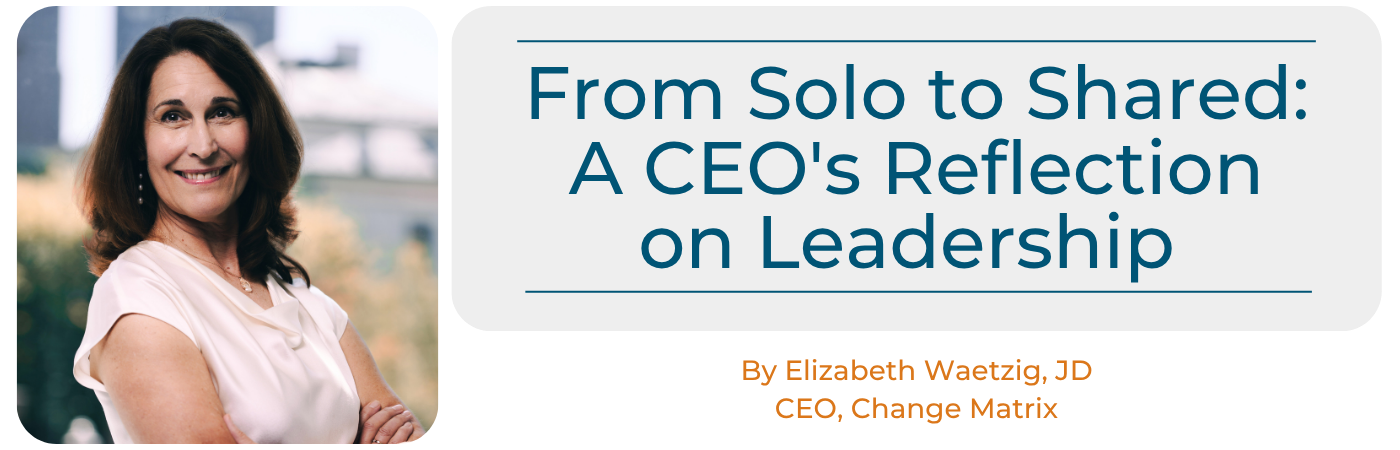
When I do leadership development work, I ask people to reflect on how their ideas about leadership emerged in childhood, when our initial thinking is shaped. This reflection helps surface deeply held assumptions and beliefs, allowing us to decide if they align with our values and choices as leaders. It also lets us examine the leadership assumptions we are socialized to hold, such as the belief that individual leaders can create complex change.
As the eldest of my generation, I was born while my parents were in medical school. Soon after my sister arrived, my father went to Vietnam, leaving my mother, a pediatric resident, with two young children. At three, I was often a quasi-parent and helper. We were raised to be responsible and considerate, valued and heard, believing in our own capabilities and in our duty to serve.
It was in college and law school that I learned some painful lessons about individual leadership, even when I thought I was exercising it for the right reasons. For example, as an elected student representative, I acted in ways I believed were right and moral. However, I lost that position when it became apparent that my actions had potential negative consequences for other students. This experience showed me that professors had more power than students. While I was acting in the service of others, guided by my own moral compass, I was ultimately acting alone.
As I began practicing law, I held a service mindset — there to help, advocate, and stand up to injustice from my place of privilege. But acting alone and on behalf of people whose experiences I did not share revealed how much I had to learn about the impact of power in service. Frustrated that I could not effect real change for those I served, I signed up for mediation training. That shift — from acting for others to creating space for people to learn through dialogue and exercise their own agency — aligned with my values and inspired my career supporting systems change through dialogue, collaboration, conflict engagement, and leadership.
Almost 20 years ago, I put those skills to work at Change Matrix (CM). For the first several years, I led the company in partnership with two other women. We started Change Matrix to motivate, manage, and measure change for communities and systems to improve lives. Leadership, systems change, equity, and evaluation and learning have been and continue to be our pillars. As the company evolved, we transitioned from three owners/partners to two of us leading together, and ultimately to my current role as sole owner and CEO. This last transition called on me to reflect on my beliefs, practices, and observations about leadership.
Through years of study, training, and leadership, I have developed beliefs that guide my evolving leadership practice. These beliefs directly reflect the importance and impact of shared leadership:
- For complex systems or social change, leadership must be shared. The results are more effective and more sustainable.
- Shared leadership must include diverse voices in a true, inclusive partnership. This requires intentional self-reflection, curiosity, and a willingness to learn and unlearn.
- The relationships and trust between participants in shared leadership are the foundation of the capacity to act. They take time to create and maintain, and sometimes a willingness to repair.
- Shared purpose must be articulated to work toward a shared vision. All participants must see mutual value in shared leadership.
- Participants in shared leadership must share resources, data, ideas, credit, and responsibility. The more you trust, the more you share.
- Diverse participants will have a variety of ideas about process, priorities, and direction. It will take time to surface, consider, and integrate them.
- Participants will have different relationships to change, risk, and conflict. Fear of loss is as powerful a motivator as safety and trust.
- Shared leadership does not evolve in a straight line — it requires curiosity and courage to stay in it. Sometimes you must go backwards.
- Shared leadership does not mean everyone plays the same role or has the same authority. It does mean that expectations regarding decision making, disagreement, and the use of power and authority must be clear and shared.
After a year of leading in transition, both at Change Matrix and in the world, I have learned so much. When moving through change processes, I reflected and grieved individually and collectively. As Rachele, the last of my partners in the company, transitioned from our shared leadership space, I first felt a sense of fear and loneliness. It took me a bit to consider our collective strengths and challenges in the company and to understand the current context within which we were operating. We have strong leaders at CM who were previously less engaged in the company’s strategy and administration. We have also faced significant uncertainty due to the change in administration. It seemed obvious to move to a more shared leadership structure; this has taken some time, and we are making progress.
Over the last year, I have relied on my learning and experience, both in my own practice and in supporting others to practice shared leadership. It is important in our time of transition as a company and as a country for me to have a vision for Change Matrix. As I form and share my vision, I have attempted to invite and be open to feedback. It is my goal to engage everyone in our company to see themselves as leaders from where they are and to work toward a shared vision.
Perhaps the most challenging — and most important — aspect of transitioning to being a CEO with more robust shared leadership is leading as a white woman in a diverse organization doing equity work. All of us have entered relationships with one another as leaders carrying existing narratives about identity, business, gender, relationships, risk, and the work. I have had to explore my own narratives, reflect on my assumptions, and examine my practice, recognizing that even when I believe I am operating with integrity and in the best interest of the organization, others may perceive me differently. These narratives are not easily identified, understood, or changed, and progress is slow.
I have worked for many years now to recognize my own privilege. I understand more about how even well-intentioned desires to serve can be undermining and based upon assumptions that are harmful and untrue. I understand that the relationships I need to build with individuals must have space for my ideas, hopes, and experiences, as well as for those of others. Those differences may require a slow building process; trust is critical and not easily given for many.
As we celebrate women’s contributions, I reflect on leadership not as a gendered trait, but as an approach rooted in shared understanding and curiosity. True leadership, I believe, listens to diverse identities and experiences, builds trustworthy relationships, and collectively improves health and well-being for all.