Coordinating Center Journey Map
“Change will not come if we wait for some other person or some other time. We are the ones we’ve been waiting for. We are the change that we seek.” -Barack Obama
Academic institutions have evolved over time based on historical priorities and interests. The result has been to continue promotion and reward structures that disproportionately advantage faculty from mainstream backgrounds who often propose white-normed research approaches and topics. While institutional racism started a long time ago, academic structures and policies – and their impacts – have evolved and remain. Current institutional leaders play a critical role in identifying and dismantling racist, exclusionary practices and policies that ultimately impact the type and quality of health equity research produced by historically underrepresented researchers and its subsequent impact on communities and society.
The Transforming Academia for Equity (TAE) initiative, conceptualized and funded by the Robert Wood Johnson Foundation (RWJF), originated from the belief that a diverse academic workforce encompasses varied perspectives and lived experiences and is well positioned to advance research agendas and opportunities for many qualified scholars—especially indigenous and racially excluded groups, people with disabilities, LGBTQ+ persons, and others. TAE is designed to unpack, understand, and shape the contextual and intervening conditions necessary for underrepresented scholars to thrive professionally and personally—and in turn, be better able to contribute to and expand health equity-related research and evidence that can help build a Culture of Health.
TAE Journey
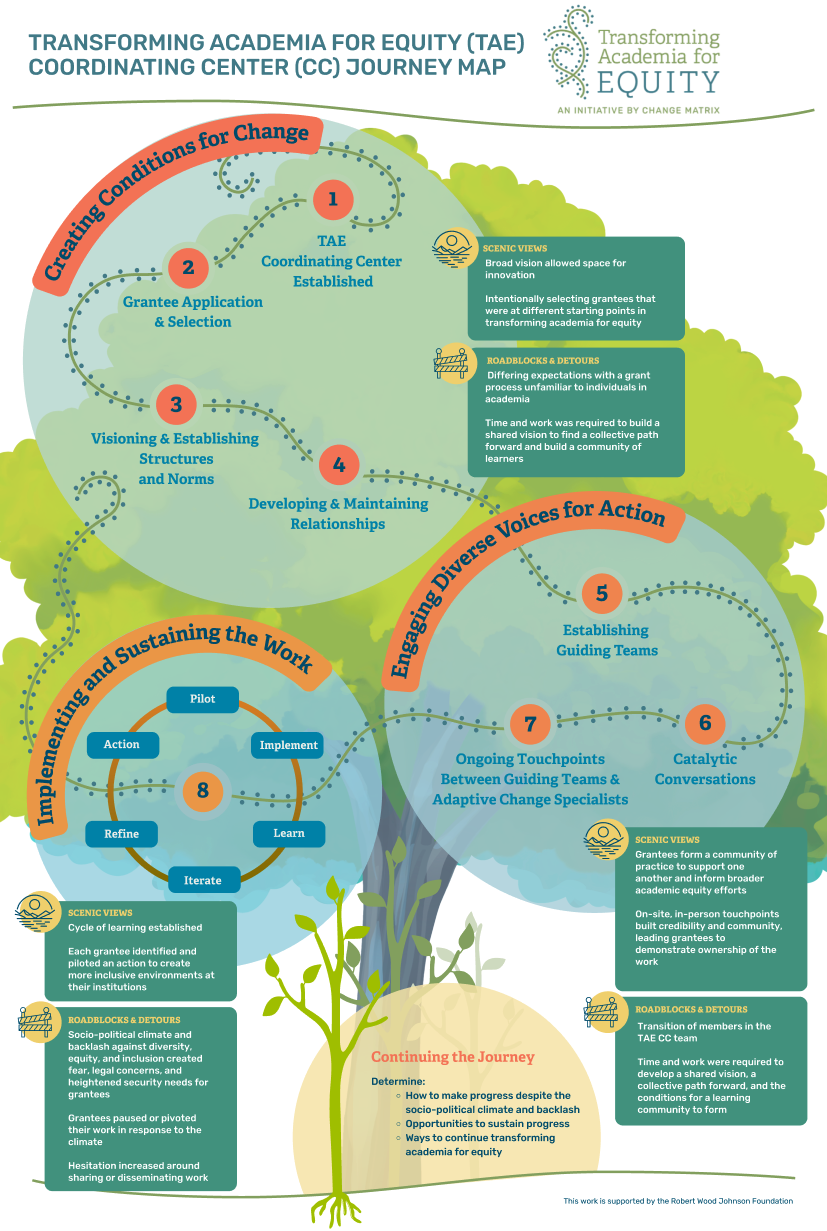
As the TAE Coordinating Center, Change Matrix leverages the collective strength of our partnerships, bringing together a diverse team of researchers, evaluators, university faculty, and experienced capacity builders – known as Adaptive Change Specialists – who use innovative and virtual techniques to support the change efforts of TAE grantees in schools and programs of public health across the country. Our Leading Through Change FrameworkTM (LTCF), which builds upon multiple leadership and change frameworks (i.e., Prochaska and DiClemente’s Stages of Change, John Kotter’s 8-Stage Model of Change, Implementation Science, and Ron Heifetz’s Adaptive Leadership), provides a structured approach for guiding organizations through complex change processes. Grounded in principles of Adaptive Leadership, the framework recognizes that meaningful organizational change requires both intentional preparation of conditions and ongoing engagement of people throughout the process. It outlines three interconnected phases that help organizations move from understanding the current landscape to sustaining long-term transformation – creating conditions for change, engaging diverse voices for action, and implementing and sustaining the work.
The following describes the Coordinating Center’s ongoing journey as we walk alongside grantees and project partners – learning what it takes to transform academia.